

Artificial Intelligence (AI) is no longer a luxury reserved for Fortune 500 corporations. In 2025-2026, we are witnessing a tectonic shift: the move from speculative fascination to pure operational efficiency.
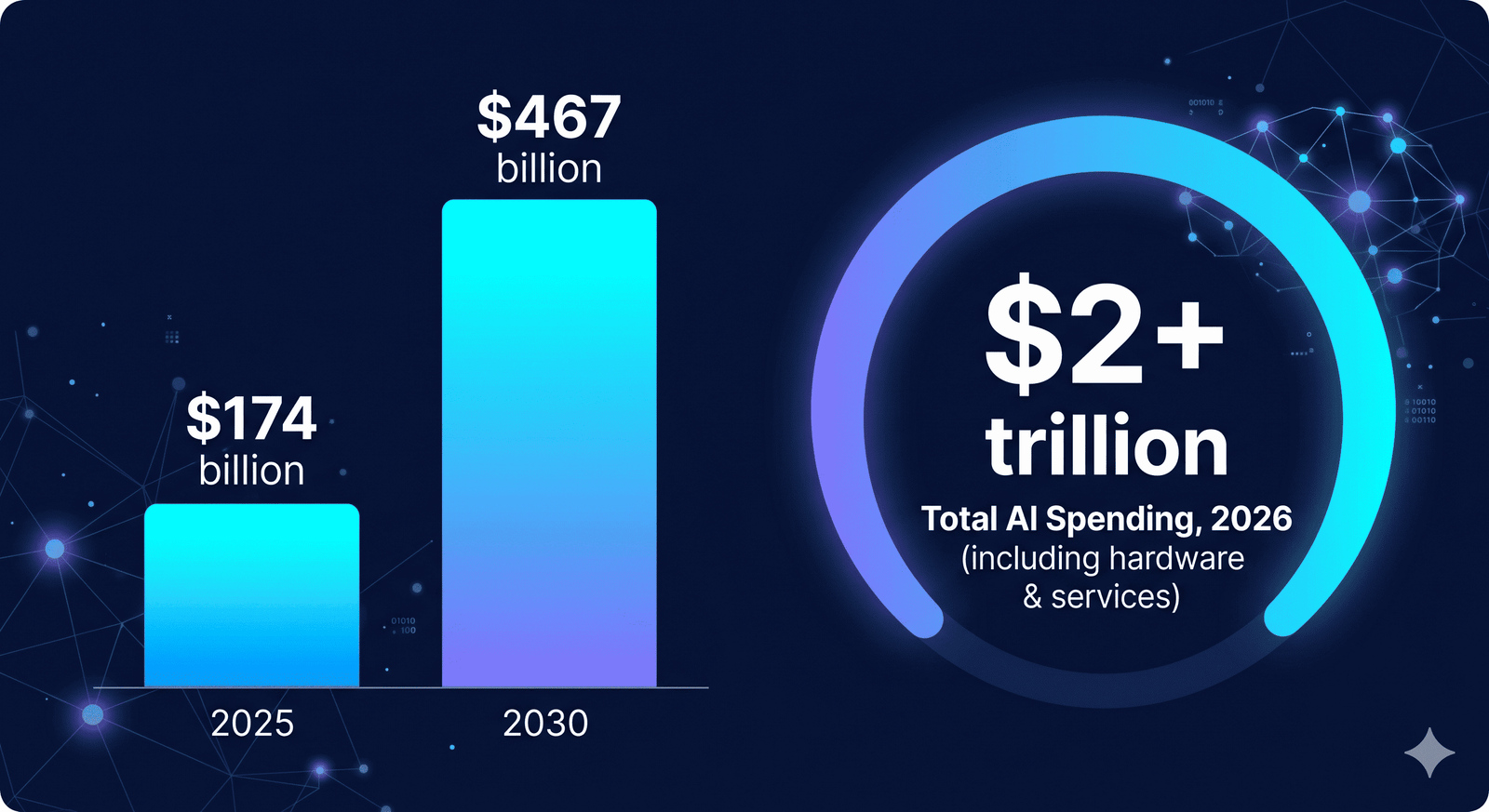
Global AI spending will exceed $2 trillion in 2026. However, the most disruptive trend isn't coming from the tech giants (hyperscalers), but from small technology companies (startups and boutiques) that are democratizing access to AI through low-cost, fast, and highly specialized implementations.
📌 Key Takeaways (Executive Summary)
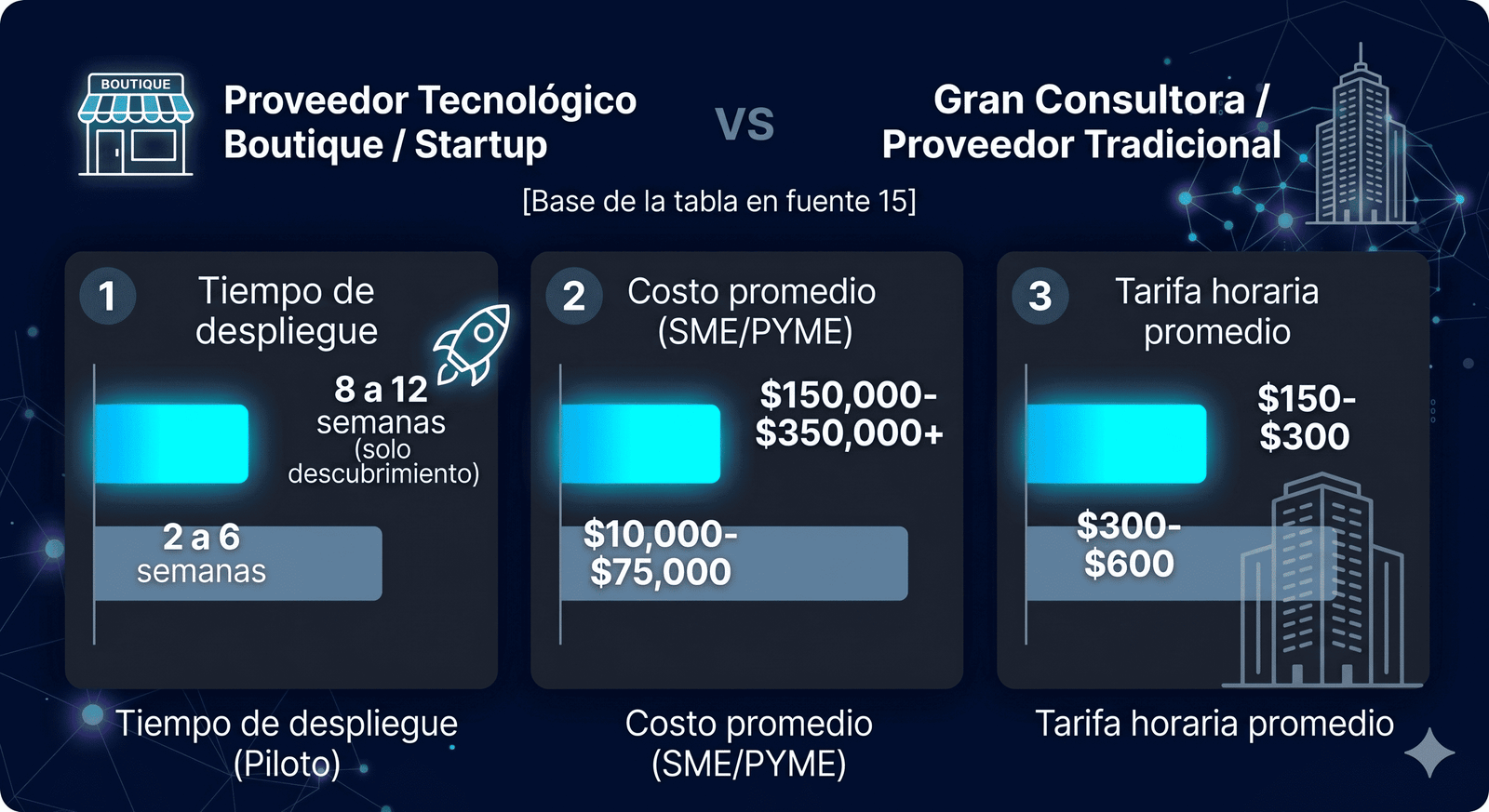
- Agility vs. Bureaucracy: Tech boutiques deploy pilots in 2 to 6 weeks, compared to the 8 to 12 weeks large consulting firms spend on the "discovery" phase alone.
- Cost Reduction: Projects for SMEs went from costing hundreds of thousands to ranging between $10,000 and $75,000 USD.
- The Enabling Technology: Retrieval-augmented generation (RAG) and Open Source models are eliminating high "pay-per-token" costs.
- SME Adoption: The AI adoption rate among small and medium-sized businesses rose from 36% in 2023 to 57% in 2025.
Why corporations are choosing "Small Tech"
The gap in value delivery between traditional providers and new AI agencies is huge. While large consulting firms inflate budgets with generic templates, boutiques offer custom architectures (such as local workflows) that avoid recurring cloud fees.
| Project Metric | AI Boutique / Startup | Large Traditional Consulting Firm |
|---|---|---|
| Deployment time (Pilot) | 2 to 6 weeks | 8 to 12 weeks (analysis only) |
| Average cost (SME) | $10,000 - $75,000 | $150,000 - $350,000+ |
| Technical approach | RAG and Open Source | Generic, proprietary frameworks |
| Execution | Senior consultants (10+ years) | Junior analysts |
The 3 sectors leading investment in agile AI
An analysis of capital flows reveals that three industries are at the forefront of this algorithmic efficiency:
1. Financial services: Leading the way in compliance
Banking and insurance demand auditability and explainability that Big Tech's "black box" models cannot provide. AI startups deliver:
- Millisecond fraud detection: Microservices that reduce false positives by 30%.
- Explainable AI: Transparent algorithms required by regulators (such as the SEC).
- Compliance automation: A 50% reduction in customer onboarding times.
_en_Servicios_Financieros.png)
2. Healthcare and life sciences: Clinical precision
With an average ROI of $3.20 for every $1 invested, healthcare is the sector most focused on sensitive data (HIPAA). Investments are concentrated on:
- Ambient Scribes: AI that documents medical consultations in real time, drastically reducing administrative burnout among staff.
- Remote Triage: Computer vision for fast diagnoses.
- Data Sovereignty: On-premise implementations that keep a human-in-the-loop.
3. Retail and commerce: Operational omnipresence
Retail is using AI to fight rising logistics costs.
- Hyper-Local Personalization: Dynamic inventory adjustments based on weather and trends, reducing forecasting errors by 50%.
- Agentic Commerce: Systems that complete transactions autonomously on behalf of the consumer.
The engine of savings: RAG and Open Source
How do these companies manage to cut costs so drastically? The answer lies in an engineering paradigm shift:
The end of constant Fine-Tuning: Instead of retraining expensive models, they use the RAG (Retrieval-Augmented Generation) architecture. The model queries the company's internal database in real time, ensuring accurate answers and eliminating hallucinations without spending on massive compute.
The Open Source revolution: 76% of companies now use open-source models (such as Llama 3 or Granite). By running them on local servers or private clouds, they eliminate the unpredictable cost of APIs ("pay-per-token") and guarantee the sovereignty of their data.
Red flags when hiring AI
If you are looking to integrate AI into your company, experts suggest evaluating providers rigorously. Walk away if you notice any of these:
- ❌ Promises of "total automation": Real enterprise AI augments human capability; it doesn't replace it entirely.
- ❌ It can't be turned off: If the system doesn't let a human override the AI's decision, it's an operational risk.
- ❌ "Black Box" systems: In regulated industries, if the algorithm can't explain why it made a decision, it's useless.
Your Next Strategic Step
Artificial intelligence in 2026 is no longer an experiment; it is the core infrastructure of your business. Success no longer depends on who has the largest model, but on who can orchestrate their data with the greatest agility.
Start small. Begin with high-impact, low-risk workflows (such as internal support automation or invoice analysis), partner with agile providers, and always prioritize control over your own data.
*Ready to make the technological leap without compromising your budget? At Neural, we are experts in designing and implementing RAG architectures and Open Source models tailored to the specific challenges of your industry.
👉 Schedule a free strategy call with Neural today and discover how we can transform your operations in weeks, not months.*